A small kitchen isn't a problem to solve so much as a space to respect. I've cooked good meals in a galley barely wide enough to turn around in, and the difference between it feeling cramped and feeling capable came down entirely to how it was set up, not how big it was.
The goal in a tight kitchen isn't to cram in more storage. It's to own less, place it well, and keep the one thing that matters most — a clear patch of counter to actually work on. Here's how I'd approach it, drawer by drawer.
Think in zones#
Professional kitchens are organised around stations, and the same idea rescues a small home kitchen. Group your things by the task they belong to, so that when you're doing a job, everything you need is within arm's reach and nothing you don't is in the way.
A simple set of zones covers almost everything:
- Prep zone — near your main counter: knives, boards, mixing bowls, measuring tools
- Cooking zone — beside the hob: oils, salt, spatulas, tongs, the pans you use most
- Storage zone — pantry and fridge: ingredients, grouped by type
- Cleaning zone — around the sink: dish soap, brushes, cloths, bin
The test is simple. Stand where you'd cook and ask whether the thing you reach for most is the thing closest to your hand. The salt should live by the stove, not across the room. Move things until the answer is yes, and cooking suddenly flows because you've stopped walking laps of a small room. In a galley or a corner kitchen that saved movement matters more than in a big one, because every extra step is a near-collision waiting to happen the moment someone else comes in for a glass of water.
Guard the counter#
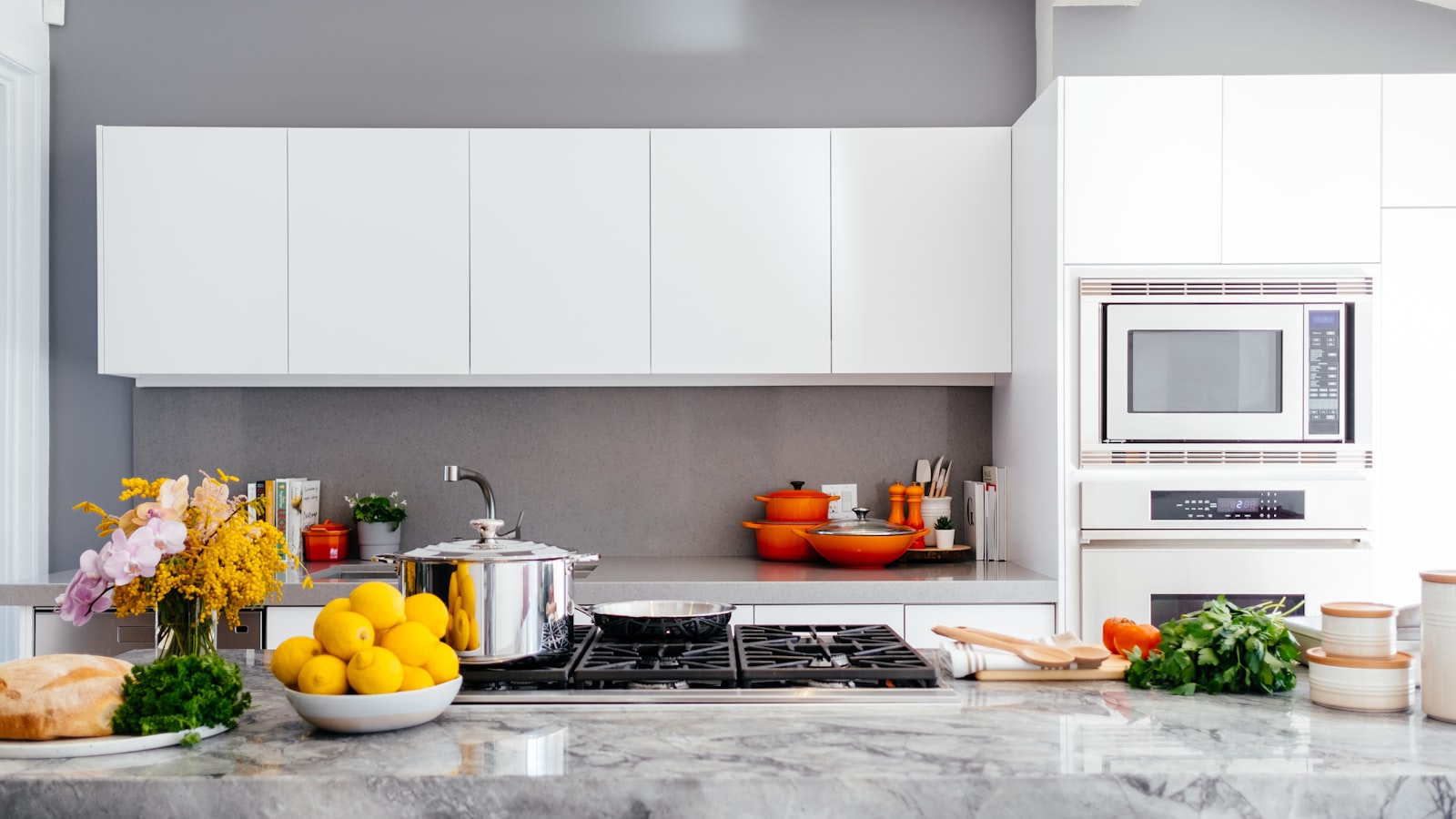
In a small kitchen, clear counter space is the most valuable thing you own, worth more than any clever gadget. It's where you chop, rest a hot pan, and lay out ingredients, and the moment it fills with clutter, cooking becomes a game of Tetris you lose every night.
So be ruthless about what earns a permanent spot on the worktop. The toaster you use daily, fine. The bread maker you touched twice last year, into a cupboard or out the door. Everything parked on the counter is renting your most expensive real estate, and most of it isn't paying enough. A good exercise is to clear the counter completely once, then only let something back onto it when you catch yourself reaching for it two days running.
If it lives on the counter, it should be something you use nearly every day. Everything else goes in a cupboard, and if it won't fit in a cupboard, that's usually a sign you don't have room to own it.
Clearing the counter is also the foundation of a calm cooking session. It's much easier to keep your kitchen clean as you cook when there's open space to work in, because mess has nowhere to accumulate.
Use the space you're not using#
Small kitchens are usually short on floor and counter but rich in walls and vertical air nobody thinks to use. Look up. The gap above your cabinets, the inside of a cupboard door, the bare wall beside the hob — all of it can carry weight.
A few cheap additions unlock a surprising amount of room:
- Hooks or a rail for hanging pans, utensils, and mugs
- A magnetic strip for knives, freeing a whole drawer and your board
- Shelf risers to double up cupboard space for plates and tins
- A narrow shelf or two on an empty wall for spices and oils
- Over-the-door organisers on the inside of cupboard doors
Drawers deserve the same thought. Dividers turn a chaotic utensil drawer into something you can actually see into, and stacking or nesting your pots reclaims a shelf. The point isn't to buy a lot of organising products; it's to use the cubic space you already have instead of just the flat surfaces. Look at the awkward dead corners too — the deep base cabinet where things vanish, the sliver of gap beside the fridge — because those are usually the last untapped storage in a small kitchen, and a pull-out basket or a slim trolley can turn wasted inches into a proper shelf.
Cut what you don't use#
No amount of clever storage fixes a kitchen with too much stuff in it. The most powerful move in a small space is subtraction, and it costs nothing. Pull everything out of a cupboard, and be honest about what you've actually used in the last few months.
Duplicates are the easy first cut. You don't need four wooden spoons, three colanders, or two half-empty bottles of the same oil. Single-use gadgets are next: the tool that only cores apples, the gizmo that only juliennes, the appliance that does one thing you could do with a knife. If a job comes up a few times a year, borrow the muscle from a tool you already own. This is exactly why it pays to be selective about the kitchen tools worth buying first — every unnecessary thing you don't buy is space you don't have to organise later.
Do the same with food. A pantry stuffed with forgotten packets isn't abundance, it's just clutter you paid for. Keep the ingredients you actually cook with, use up the stragglers, and your cupboards suddenly breathe. An edited pantry has a hidden benefit as well: you can finally see what you own, so you stop buying duplicates and start cooking through what's already there.
Keep it working#
Organising a kitchen once is easy; keeping it organised is the real skill, and it comes down to small daily habits rather than a big annual purge. Put things back in their zone as you finish with them. Deal with the post and packaging that drifts onto the counter. Every few weeks, catch the drawer that's started to slide back into chaos before it gets bad.
The reward is a space that feels bigger than its footprint. A well-set-up small kitchen can be a joy to cook in — everything to hand, nothing in the way, no wasted steps. Some of the best food I've eaten came out of kitchens you could barely swing a spoon in, which tells you the square footage was never really the point. Respect the space, keep the counter clear, use every wall, and own only what you use, and you'll find that a small kitchen was never the thing holding your cooking back.