The chef's knife is the one tool that changes how cooking feels. Once it stops fighting you, prep gets quicker, quieter, and a lot less annoying, and dinner starts to feel possible on a weeknight. Most people never get there because nobody showed them the two things that matter: how to hold the knife, and what the other hand is doing.
I spent years on a line where slow prep meant a slammed service, so I learned this the blunt way. None of it is complicated. It's a handful of habits that feel awkward for a week and then become the only way you'd ever want to cut.
Hold the knife like you mean it#
Grab a chef's knife the way most people do and your hand ends up wrapped around the handle, fist closed, blade wobbling out front. It feels safe. It isn't, and it's why the blade skates around instead of going where you point it.
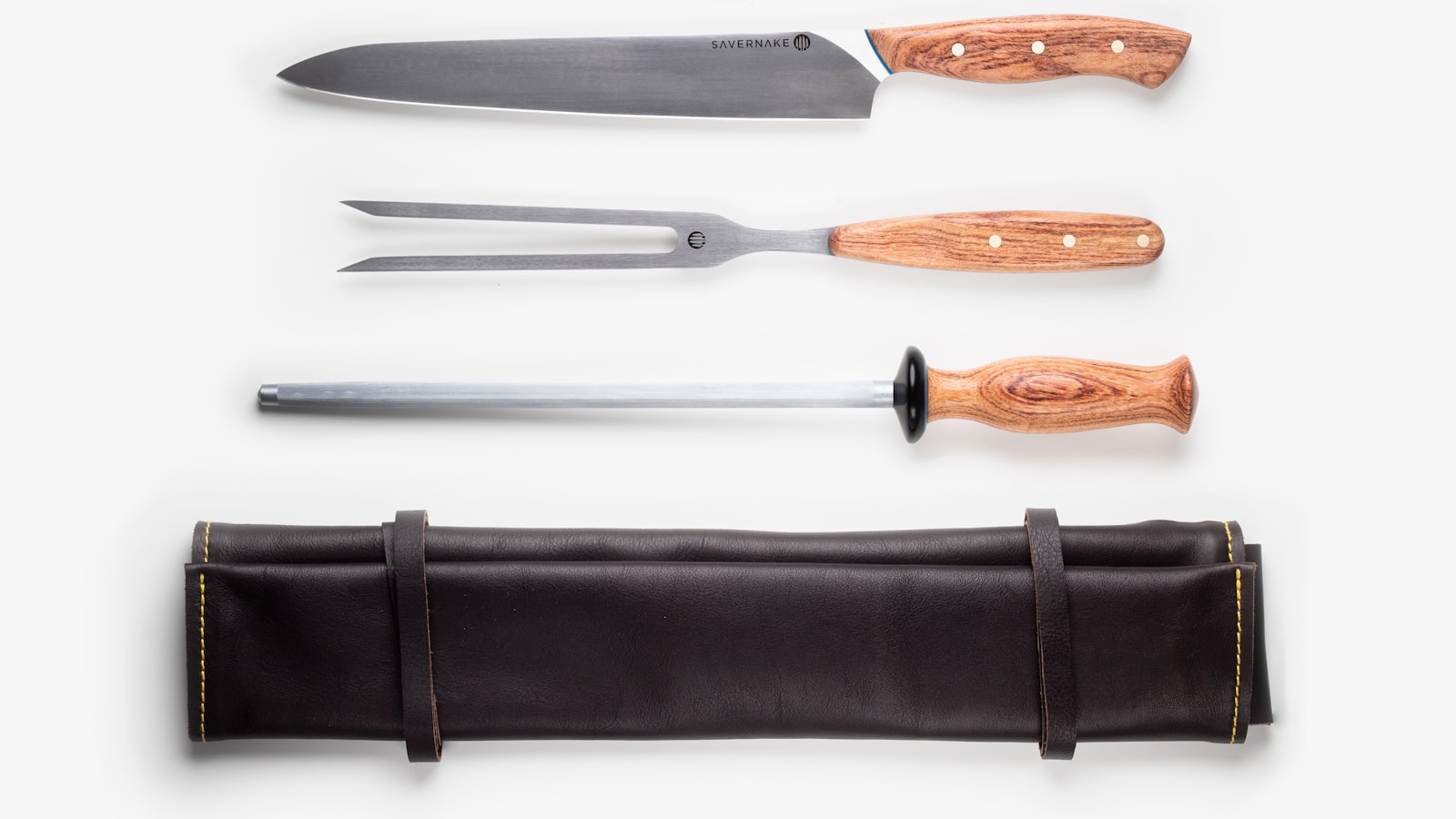
The grip that works is the pinch. Slide your hand forward so your thumb and the side of your index finger pinch the blade itself, just ahead of the handle where the metal widens. Your other three fingers curl around the handle for support. That pinch puts your hand at the knife's balance point, so the blade becomes an extension of your arm rather than a thing dangling off the end of a stick.
It will feel strange at first, maybe even wrong. Push through that. Within a few days you'll notice the tip stops drifting and cuts land where you intend them to. A pinch grip also lets you rock the knife smoothly, which matters more than raw speed.
Your other hand is the one that matters#
Everyone worries about the knife hand. The hand that actually keeps you safe, and makes your cuts even, is the one holding the food. Left to its own devices it splays flat with fingertips pointing straight at the blade, which is exactly how people nick themselves.
Instead, curl that hand into a claw. Tuck your fingertips under so your first knuckles face the blade, and let the flat of the knife rest lightly against those knuckles as you cut. The knuckles become a wall that guides the blade, and because your fingertips are hidden behind them, there's nothing for the edge to reach. Your thumb tucks back behind your fingers, never poking out to the side.
Here's the part that ties it together:
- The claw hand sets the width of each slice by how far back it steps
- The knife slides down the flat of your knuckles, so it can't wander sideways
- You move the food to the blade; the blade doesn't chase the food
Cut slowly and correctly first. Speed is just the same correct movement repeated until it feels automatic — it arrives on its own once the shape is right, and it never arrives if you start out sloppy and fast.
Watch anyone who cooks for a living and you'll see the claw before you see anything flashy. It's the whole game.
Set up your board so nothing slips#
A cutting board that slides is a genuine hazard, and it's the easiest thing in the kitchen to fix. Lay a damp paper towel or a thin kitchen cloth flat under the board before you start. That grip alone removes most of the wobble that makes people tense up and lose control.
Give yourself a real board, too. A tiny one crowds your work and pushes food off the edges, so you spend half your time herding scraps instead of cutting. Bigger is calmer. Keep a bowl nearby for trimmings and peels so your surface stays clear, which is the same clear-as-you-go habit that keeps the rest of your kitchen clean while you cook.
Stand square to the board with your feet a little apart, and keep your elbow relaxed at your side rather than winged out. Good cutting comes from a loose shoulder and a steady hand, not from muscling down through the food.
Learn a few cuts, not a hundred#
You don't need the full culinary-school vocabulary. A handful of movements will carry you through nearly everything you cook at home, and it's better to own four cuts than to fumble twelve.
The rock chop is the workhorse. Keep the tip of the knife on the board, lift the heel, and rock the blade down and forward through herbs, garlic, and onions while your claw hand feeds the food along. Because the tip never fully leaves the board, the motion stays controlled and quick.
For firmer vegetables like carrots and potatoes, use a straight push cut: guide the blade down and slightly forward in one smooth stroke, then draw it back to reset. Let the sharpness do the work; if you're sawing or leaning your body weight into it, the knife is dull, not weak.
Cutting even sizes matters more than cutting pretty ones. Pieces that match in size cook at the same rate, which is the difference between vegetables that are all done at once and a pan where some are burnt while others stay raw. That evenness pays off directly when you roast vegetables so they caramelize, where ragged cuts cook unevenly and never brown right.
Keep it sharp, keep it safe#
This is the part people get backwards. A dull knife feels safer because it seems less likely to cut you, but the opposite is true. A dull edge skids off the food instead of biting in, and a skidding blade with force behind it goes wherever it wants, often into you. Sharp knives do what you tell them.
Two tools keep an edge honest. A honing steel, run along the blade a few strokes before you cook, straightens the fine edge that folds over with normal use and keeps a decent knife feeling crisp for weeks. Actual sharpening, which removes metal to rebuild the edge, you do far less often, with a whetstone or a pull-through sharpener or by handing it to someone who does it well.
A few plain safety habits round it out:
- Never try to catch a falling knife; step back and let it land
- Carry a knife point-down at your side, edge behind you, blade never waving around
- Never leave a knife hidden in a sink of soapy water where a hand will find it edge-first
- Wash and dry it by hand right after use, and keep it off the pile of dishes
Store the knife where the edge is protected, whether that's a magnetic strip, a block, or a simple blade guard in a drawer. Letting it clatter loose against other metal dulls it fast and turns the drawer into a place you reach into carefully.
Give it a week#
Nobody holds a chef's knife well the first day, and the pinch grip and the claw both feel clumsy before they feel like second nature. Slice an onion, then another, then a few carrots, moving slower than you think you need to. Your hands learn the shape faster than you'd expect, and one evening you'll realize you've stopped thinking about it entirely.
Get comfortable here and the rest of the kitchen opens up, because almost every recipe starts with cutting something. If you're stocking a kitchen from scratch, this is the skill that makes the first tools worth buying pay off; see the kitchen tools worth buying first for what actually earns its place. Sharpen the knife, set your board, make the claw, and cook.